Connect Your Ecommerce Website to Sage 50 Without Slowing Your Business
Ecommerce Has Become the Primary Route to Market
For many businesses, ecommerce has become the primary route to market. Whether you sell through your own website, online marketplaces or a combination of both, customers expect accurate stock levels, up-to-date pricing and fast order processing.
Integrating your ecommerce platform with Sage 50 can automate much of this work, eliminating manual data entry and ensuring orders flow directly into your business.
However, as online sales grow, many businesses begin experiencing an unexpected problem.
The very integration designed to save time can become one of the biggest causes of Sage 50 performance issues.
Understanding why this happens is the first step towards building an ecommerce solution that can continue supporting your business as it grows.
Why Integrate Ecommerce with Sage 50?
Without integration, office staff often spend hours each day manually entering online orders into Sage. Products must be updated in several different systems. Stock levels can become inaccurate. Pricing changes need to be repeated multiple times.
This creates unnecessary administration and increases the risk of errors.
A properly integrated ecommerce solution can automatically:
These improvements save considerable administration and provide customers with more accurate information.
The Hidden Problem with Traditional Ecommerce Integration
Most ecommerce integrations communicate directly with Sage 50. Every few minutes they request information such as:
- Product details.
- Product descriptions.
- Selling prices.
- Stock availability.
- Customer information.
- Sales orders.
As online sales increase, these requests become more frequent. A business selling hundreds of products each day may generate thousands of database requests before lunchtime.
If several ecommerce platforms are connected simultaneously, Sage can spend much of the day responding to website requests rather than supporting office staff.
Many businesses don’t realise this is happening because the communication takes place automatically in the background.
More Sales Mean More Database Activity
Business growth is always welcome. However, increasing online sales naturally generate more operational activity.
As Orders Increase, Sage Is Continually Processing
- Product lookups.
- Price checks.
- Stock availability requests.
- Customer creation.
- Order imports.
- Stock updates.
- Dispatch information.
At the Same Time Office Staff Continue Using Sage For
- Sales order processing.
- Purchase orders.
- Financial accounting.
- Reporting.
- Customer enquiries.
The result is that Sage becomes responsible for supporting both your business users and your ecommerce systems simultaneously.
Multiple Sales Channels Increase the Workload
Many businesses no longer operate a single online shop. Instead they sell through multiple channels including:
Each platform expects access to the same information. Without careful planning, every platform communicates directly with Sage.
As additional channels are introduced, database activity increases accordingly.
Is Sage the Best Place to Store Operational Data?
This is an important question. Sage 50 is an excellent accounting system.
Its Primary Role Is to Manage
- Financial accounting.
- Customer accounts.
- Supplier accounts.
- VAT.
- Banking.
- Financial reporting.
Increasingly, However, Businesses Expect Sage to Become the Operational Data Source For
- Websites.
- Marketplaces.
- Warehouse management.
- Barcode scanning.
- Courier systems.
- Product management.
As businesses expand, this places a significant operational workload on the accounting system.
A Different Approach to Ecommerce Integration
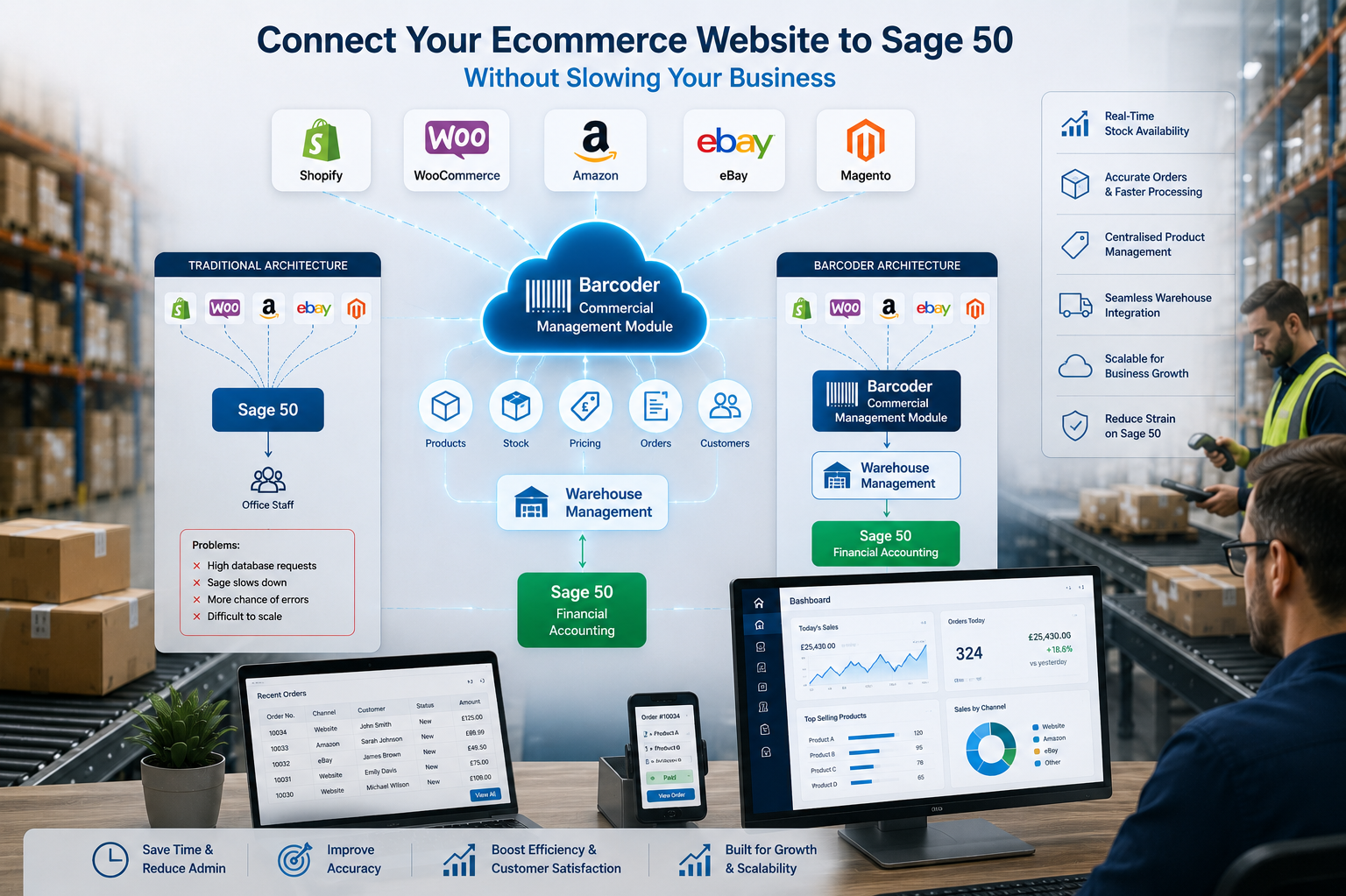
At ES Consulting we believe there is a better way. Rather than connecting ecommerce platforms directly to Sage, the Barcoder Commercial Management Module becomes the operational hub for your business.
Instead of every website requesting information from Sage, ecommerce platforms communicate directly with Barcoder. Barcoder manages:
- Product information.
- Stock availability.
- Customer quotations.
- Sales order processing.
- Purchase order processing.
- Customer pricing.
- Supplier pricing.
Financial information is then synchronised with Sage 50. This architecture dramatically reduces the workload placed on Sage while providing a faster and more scalable operational platform.

Traditional Architecture vs Barcoder Architecture
Everything communicates directly with Sage.
Every stock enquiry. Every product update. Every order. Every price change.
Sage continues to manage accounts.
Barcoder manages commercial operations.
Real-Time Stock Availability
Customers expect stock information to be accurate. Nothing damages customer confidence more than ordering products that are no longer available.
The Barcoder Commercial Management Module maintains accurate operational stock information while synchronising financial stock movements with Sage. This provides:
Product Management Made Easier
As product catalogues grow, maintaining accurate ecommerce information becomes increasingly important. Barcoder allows businesses to manage:
This information can then be distributed across multiple ecommerce platforms from a single operational system.
Warehouse Integration
One of the biggest advantages of using Barcoder is its seamless integration with the Barcoder Warehouse Management System.
Online orders can move directly from your ecommerce platform into warehouse picking without unnecessary manual intervention. Warehouse staff can:
- Pick using barcode scanners.
- Confirm dispatch.
- Update stock immediately.
- Generate delivery documentation.
- Synchronise completed transactions with Sage.
Built for Growing Businesses
The Barcoder Commercial Management Module has been designed for organisations experiencing rapid growth. It is particularly suitable for:
Whether you manage thousands of products or process hundreds of online orders every day, the system provides a scalable operational platform that grows alongside your business.
Frequently Asked Questions
Which ecommerce platforms are supported?
The Barcoder Commercial Management Module can integrate with a wide range of ecommerce platforms including Shopify, WooCommerce, Amazon, eBay, Magento, OpenCart and bespoke websites using our API.
Does Barcoder replace Sage 50?
No. Sage remains your financial accounting system while Barcoder manages commercial operations and ecommerce integration.
Can Barcoder update stock levels automatically?
Yes. Stock movements can be synchronised automatically, ensuring ecommerce platforms display accurate availability.
Does Barcoder integrate with the Barcoder Warehouse Management System?
Yes. The Commercial Management Module forms part of the Barcoder 250 Cloud platform and integrates seamlessly with warehouse management, barcode scanning, goods received and goods despatched.
Can I connect more than one ecommerce website?
Yes. Many of our customers operate multiple ecommerce websites and marketplace accounts simultaneously. Barcoder has been designed to support multi-channel selling while reducing the workload placed on Sage.
See a Smarter Approach to Ecommerce Integration
If your ecommerce business has grown to the point where Sage 50 is struggling to keep pace, we’d be pleased to demonstrate how the Barcoder Commercial Management Module provides a more scalable approach.
By allowing Barcoder to become the operational hub for ecommerce, product management and commercial processing, Sage can remain focused on financial accounting while your business continues to grow.
Contact ES Consulting today to arrange a demonstration and discover how modern ecommerce integration can improve performance without replacing the accounting system you already know and trust.
Arrange a Demonstration