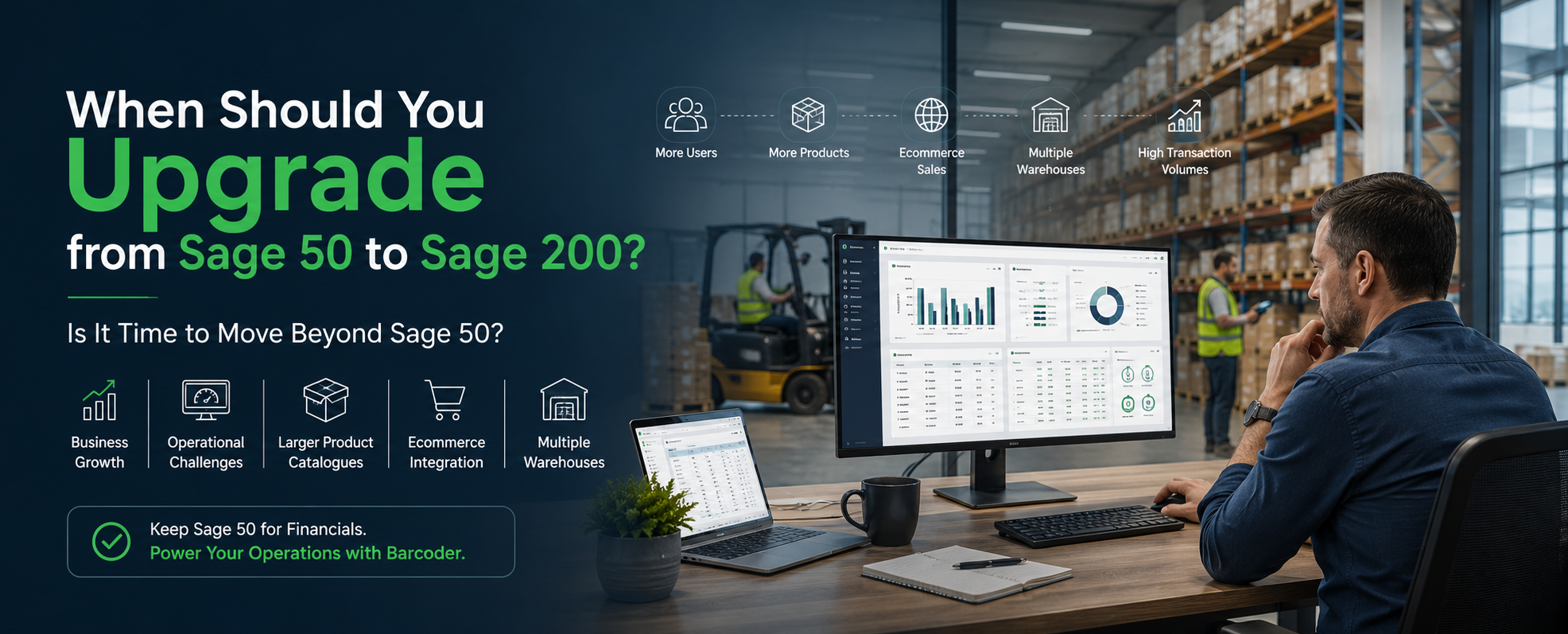
When Should You Upgrade from Sage 50 to Sage 200?
Is It Time to Move Beyond Sage 50?
One of the Most Common Questions We Hear from Growing Businesses
“Have we reached the point where we need to upgrade from Sage 50 to Sage 200?”
It’s an important question, and for many businesses it represents one of the biggest software decisions they will make.
Moving to a new ERP system involves a significant investment in software, implementation, training and business change. It is therefore important to understand why you are considering an upgrade before deciding that a completely new accounting system is the only solution.
The reality is that every growing business eventually reaches a point where it needs to review its systems. The challenge is deciding whether the issue lies with your accounting software or with the way your business now operates.
Why Businesses Consider Moving to Sage 200
Most businesses don’t begin researching Sage 200 because they want new accounting features. Instead, they usually start by experiencing operational problems such as:
These challenges are often a natural consequence of business growth.
The assumption is that because Sage has become slower, the business has outgrown Sage 50. Sometimes that assumption is correct. Sometimes it isn’t.
When Sage 200 Is Absolutely the Right Choice
Sage 200 is an excellent ERP solution and is the right choice for many organisations. Typical reasons for upgrading include:
Advanced Financial Management
Businesses requiring sophisticated financial reporting, departmental accounting or more advanced budgeting often benefit from Sage 200.
Multi-Company Accounting
If your organisation manages several companies and requires consolidated financial reporting, Sage 200 provides functionality beyond that available in Sage 50.
Manufacturing
Businesses with advanced manufacturing, production planning and complex works order requirements often require a full ERP platform.
Enterprise Business Processes
Large organisations with many departments, extensive approval workflows and complex operational requirements may benefit from Sage 200’s broader ERP capabilities.
Future Strategic Growth
Some businesses simply decide they want to invest in an enterprise platform that will support future expansion for many years to come.
In these situations, Sage 200 can be an excellent investment.
But What If Your Biggest Problem Isn’t Accounting?
This is where many businesses find themselves. When we first speak to new customers, they rarely say:
“We need more financial reports.”
Instead they tell us:
“Sage is running slowly.”
“Product searches take too long.”
“Our ecommerce website is slowing everything down.”
“Warehouse staff are waiting for information.”
“Sales order processing is becoming difficult.”
Notice that these are operational challenges rather than accounting challenges. The financial side of Sage often continues to work extremely well.
The pressure comes from asking Sage to manage every commercial process within the business.
Has Your Business Changed?
Think back to when Sage 50 was first installed.
Your Business May Have Had
- One warehouse.
- A few thousand products.
- Three or four users.
- No ecommerce.
- A handful of daily sales orders.
Today Your Business Might Have
- Multiple warehouses.
- Tens of thousands of products.
- Barcode scanning.
- Shopify or WooCommerce.
- Amazon and eBay.
- Fifteen office users.
- Hundreds of sales orders every day.
Your accounting requirements may not have changed dramatically. Your operational requirements certainly have.
Is Sage 50 Being Used for Too Much?
Over time many businesses gradually ask Sage to become responsible for:
Every one of these activities generates additional workload.
Eventually Sage is no longer just the accounting system. It has become the operational centre of the business.
An Alternative Approach
Before investing in a completely new ERP system, it is worth asking another question.
Do you actually need a different accounting system? Or… Do you simply need a better operational system?
These are very different questions. Many businesses still find Sage 50 perfectly capable of managing:
- Financial accounting.
- VAT.
- Banking.
- Customer accounts.
- Supplier accounts.
- Financial reporting.
The operational workload is often the real issue.

Introducing the Barcoder Commercial Management Module
The Barcoder Commercial Management Module has been developed specifically for growing businesses that have outgrown the operational capabilities of Sage 50.
Rather than replacing Sage, Barcoder becomes the commercial and operational platform while Sage continues to manage financial accounting. The Commercial Management Module manages:
- Customer quotations.
- Sales order processing.
- Purchase order processing.
- Product management.
- Customer pricing.
- Supplier pricing.
- Ecommerce integration.
- Commercial workflows.
Meanwhile Sage continues to perform the accounting functions it was originally designed for.
Comparing Your Options
There is no universally correct answer. The right solution depends on the challenges your business is trying to solve.
| Requirement | Continue with Sage 50 | Sage 50 + Barcoder | Sage 200 |
|---|---|---|---|
| Financial accounting | |||
| Modern commercial management | Limited | ||
| Browser-based operation | |||
| Large product catalogues | Limited | ||
| Ecommerce integration | Direct | Via Barcoder | |
| Warehouse management | Limited | Full integration | Available |
| Barcode scanning | Limited | Full integration | Available |
| Staff retraining | None | Minimal | Significant |
| Typical implementation cost | Low | Moderate | Higher |
| ERP functionality | Basic | Operational management | Comprehensive ERP |
Which Businesses Benefit Most from Each Option?
Continue with Sage 50
Suitable for businesses whose accounting and operational requirements remain relatively straightforward.
Sage 50 with the Barcoder Commercial Management Module
Ideal for businesses experiencing:
- Large product catalogues.
- High transaction volumes.
- Ecommerce growth.
- Warehouse expansion.
- Barcode scanning.
- Operational performance issues.
This approach allows businesses to continue using Sage while introducing a modern operational platform.
Sage 200
Recommended for businesses requiring:
- Enterprise ERP functionality.
- Advanced manufacturing.
- Multi-company accounting.
- Sophisticated financial management.
- Complex organisational structures.
Frequently Asked Questions
Is Sage 200 always better than Sage 50?
No. The two products are designed for different types of businesses and different operational requirements.
Does every growing business need Sage 200?
Not necessarily. Many businesses continue using Sage 50 successfully for financial accounting while extending operational functionality using specialist software.
Can I continue using Sage 50 if my business keeps growing?
In many cases, yes. The key is ensuring that Sage is used primarily for financial accounting rather than every operational process within the business.
Does the Barcoder Commercial Management Module replace Sage?
No. It complements Sage by managing commercial operations while Sage continues to manage financial accounting.
Can I move to Sage 200 later?
Yes. Many businesses choose to introduce better operational processes first and then review their accounting platform at a later date as the business continues to grow.
Final Thoughts
Every successful business reaches a point where it needs to review its systems. That does not automatically mean replacing everything that already works.
Sage 50 remains an excellent accounting solution for many growing organisations.
The important question is not:
“Should we replace Sage?”
It is:
“What problem are we trying to solve?”
If the challenge is enterprise financial management, Sage 200 may well be the right investment.
If the challenge is operational workload created by sales order processing, warehouse management, ecommerce integration and large product catalogues, there may be a more practical alternative.
Understanding that difference can save considerable cost, minimise disruption and allow your business to continue growing using the accounting system your staff already know.
Talk to Us Before You Invest in a New ERP System
If you’re considering upgrading from Sage 50 to Sage 200, we’d be pleased to discuss your current business processes before you make that investment.
After more than 25 years working with Sage users across the UK and Ireland, we’ve helped many organisations determine whether they genuinely needed a new ERP system or whether extending Sage 50 with modern commercial and warehouse management functionality was the better option.
Arrange a demonstration with ES Consulting to explore the options available and choose the solution that best supports your business today and in the future.
Arrange a Consultation